A goal without a plan is just a wish – Antoine de Saint-Exupery
If there is one thing that is absolutely essential to successfully prepare your way to a great GMAT score it is a structured GMAT Study Plan that is executed perfectly.
It is tough to make a one-size-fits-all study plan for those who want to prepare on their own. Instead we will take up each of the elements of your preparation and discuss those in detail.
What you should not do
Given that the GMAT is predictable and there is a seemingly huge quantity of actual GMAT questions to practice along two official free tests the usual pattern that test-takers follow unfolds as follows.
Take a mock test without any preparation – some test-takers use the first test from the GMAT Prep Software, others use a free test from a reputable source such as Kaplan, some others just take any random GMAT Mock that they can find.
Firstly, no test from any player in the market actually simulates the GMAT. The failure occurs on two counts: the questions are not consistently tailored to the GMAT logic and lack of knowledge of the exact adaptive algorithm (which of course is proprietary to the GMAC) that the GMAT uses. So any unofficial test that you take is not a reliable indicator of your ability.
If you take the GMAT Prep Software test, you will waste one full-length test right at the beginning of your preparation instead of saving it for later.
After taking this mock, test-takers gather prep materials from various sources and swing back and forth between taking tests and preparing.
After a few months of this, a certain proportion just go ahead take the actual test to see how it goes, others decide that they need some professional help and then try some test-prep courses, still others postpone their plans!
I am not saying that this plan will not work; it will work only if you hit a 680 or above on the first test you take.
The Elements Of A Successful GMAT Prep
A GMAT attempt can be called a successful if you reach the minimum possible score for your potential in your first attempt. There is a reason we have defined it as minimum possible and not maximum possible score. Every test-taker will potentially fall into a band in terms of the score he or she can get. On test day, unless anything goes wrong dramatically, he or she will fall into that band. This band is usually 20 points wide. So your range can be 680-700 or 700-720 and so on. There will always be exceptions to this but in most cases this range holds true.
To achieve this minimum possible score you need to do implement the plan below:
Step 1: Take the Paper-Based Diagnostic Test From the Official Guide & Identify Your Learning Needs
While it is imperative that one takes a Diagnostic Test, it does not need to be full-length computer-adaptive test. The objective is not to a get a precise score to benchmark your ability but to measure your ability on the 5 question-types posed on the GMAT and identify your learning needs. For this the paper-based Diagnostic Test at the beginning of the OG should more than suffice.
The Diagnostic Test can be taken one section at a time or one question-type (PS, DS, CR, RC & SC) at a time. Do not take start a question type and leave it mid-way. Do not take it as a full-length test unless you have the stamina and time to sit through. The idea is to get a measure of your competence based on knowledge and aptitude, which can get compromised if you are mentally tired.
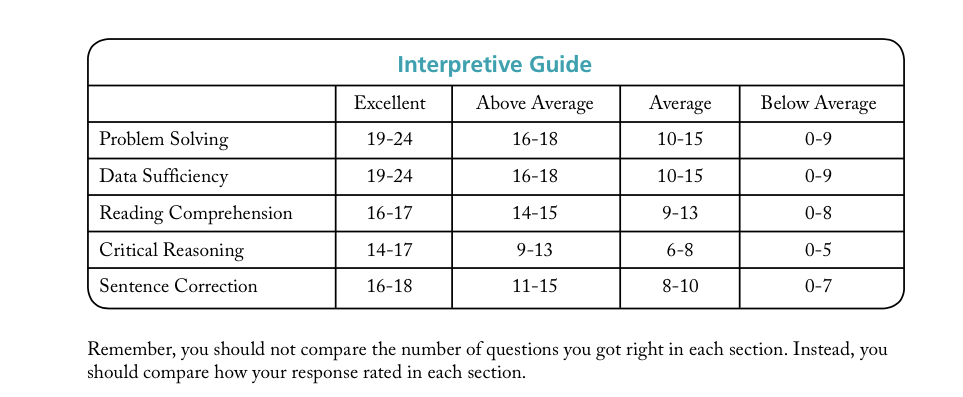
Based on the number of questions you answer correctly you will get a rating for your competence level in each area: Excellent, Above Average, Average, Below Average. This will give you an idea about your relative strengths and weaknesses.
For Quant you would need to deep dive beyond PS & DS into the mistakes to determine the specific topics on which you need to work on such as Rate & Work, Statistics etc.
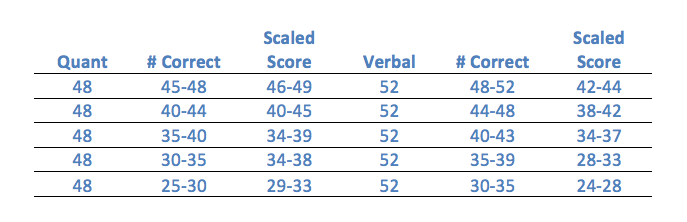
This post will outline how to approximate your performance on the OG Diagnostic Test to the 800-scale.
Step 2: Build Concepts & Strategies
Once you have identified your level of competence in each of the areas you should start learning the concepts & strategies required to solve each question type.
Most test-takers confuse the practice stage with this stage — they either start solving questions from the OG, trying to learn as they solve or do the learning and solving simultaneously.
Both these approaches are incorrect. For example, there is a certain technique to solve DS questions in such a way that you do not make any mistakes. The same applies to solving a Weaken Question on Critical Reasoning question or Sentence Correction question testing Parallelism.
The GMAT looks very straightforward to most test-takers —
• Quant is barely X-grade level, I just need to cut down on silly mistakes
• Critical Reasoning is just common sense
• Sentence Correction is anyways about gut-feel, whenever I make a mistake I can look at the explanatory answer and learn
• Reading Comprehension — well who wants solve that anyways
So I can start solving and learning in parallel (I know this does not apply to all but it does to most). In a way the approach mirrors the approach to a video game; just keep trying and eventually you will hit the higher levels.
The only problem with this method is that you will run out of actual GMAT questions very soon without actually learning anything.
One of the things about preparing for the GMAT is that very few practice question banks in the market actually simulate the GMAT logic. Given this it is imperative that whatever little Official Material is available be used judiciously.
So your next questions should be what prep material should you use to build concepts & strategies and whether classroom prep is required for the GMAT. We will take both of these questions up in forthcoming posts.
Step 3: Practice with a purpose
Once you are through with your concept prep you need to start practicing questions from the Official Guide. But this practice must be done with a certain amount of thought and purpose
Normally test-takers practice one question type at a time in huge chunks, say, 40 CR questions in a row or 30 SC questions in a row before moving on to other question-types.
The problem with this is that this is not the format in which you face questions in the test.
On the actual test you will reach the Verbal Section only after 2.5 hours of testing. This in itself is the biggest hurdle for Indian test-takers. The amount of reading that the Verbal section requires takes more out of most Indian test-takers than out of test-takers who are native speakers of the English language.
Your practice routine as much as possible will have to mimic the actual test conditions and pattern as much as possible.
You can use the following practice routine with a 5-minute break between the Quant and Verbal sections:
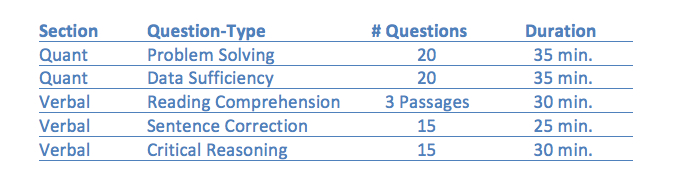
The above practice routine is intended to help you simulate the actual test conditions, as much as possible, right from the beginning of your practice and not when you start taking full-length tests. As you proceed in your prep (about half-way through the OG), you should add AWA & IR questions to your practice routines.
Step 4: Testing To Improve
As discussed in the previous post your would need at the least a 30-45 window for your testing period.
The most crucial part of this exercise is how you analyze your tests and identify exactly what you need to do to improve your score.
For example, test-takers often say that in Quant they make silly mistakes — an equivalent of an unforced error in tennis. But beyond this they do not seem have a strategy to cut down on them. Suppose a tennis-player is making unforced errors and you need to fix this you need go beyond the surface:
• Are there more errors on the forehand or backhand?
• Do they go more into the net or does he/she hit them long?
From such question sit is possible to figure out the technical problem behind these seemingly unforced errors. Even on the GMAT Quant silly mistakes are not purely a matter of oversight.
For example, you might be actually reading the question incorrectly – you start reading the question at the right pace and concentration but as you reach the end of it you read it in a hurry and skim details in order to start solving it.
Most test-takers during their test review will just categorize this as – Oh I could have easily got this there is nothing I need to learn, it is just a silly mistake. Very few silly mistakes are truly silly; a deeper inspection always reveals faulty technique.
We will take this up in detail in a later post on how to achieve maximum score improvement during the testing phase.
Will roll the next few posts related to this post in quick succession. In the meantime those who have not taken the Diagnostic Test in the OG can go ahead and give it a shot. Remember do not solve it casually — take it when your are fresh and take it with full concentration.









 The GMAT Writer