All posts tagged: GMAT Prep

How To Approximate Your OG Diagnostic Test Performance To The 800-Scale

As mentioned in this post, the first step of your GMAT Prep begins with taking a Diagnostic Test. This need not be a computer adaptive test, the paper-based Diagnostic Test on the OG will suffice. A few rules that need to be followed while taking the test: • Take the test when you are fresh so that you can get the most accurate measure of your competence; you should not have anything other than your own ability to attribute a sub-par performance to. • The test can be taken either as two sections – Quant and Verbal with any length of break in between (even a day or two) – or as five question-types (PS, DS, RC, CR & SC). • Do not break the test either in the middle of a section or in the middle of a question-type. Your performance across five categories will be categorized as shown in the table below. Before we approximate this performance to a score on the 800-scale we have to take a few things into consideration that …


How To Structure Your GMAT Prep

A goal without a plan is just a wish – Antoine de Saint-Exupery If there is one thing that is absolutely essential to successfully prepare your way to a great GMAT score it is a structured GMAT Study Plan that is executed perfectly. It is tough to make a one-size-fits-all study plan for those who want to prepare on their own. Instead we will take up each of the elements of your preparation and discuss those in detail. What you should not do Given that the GMAT is predictable and there is a seemingly huge quantity of actual GMAT questions to practice along two official free tests the usual pattern that test-takers follow unfolds as follows. Take a mock test without any preparation – some test-takers use the first test from the GMAT Prep Software, others use a free test from a reputable source such as Kaplan, some others just take any random GMAT Mock that they can find. Firstly, no test from any player in the market actually simulates the GMAT. The failure occurs …

What is the optimum time to prepare for the GMAT?

This is the first question that pops up regarding test-preparation, be it for the GMAT or for any other test. The short answer to this question — it will require a minimum of 2.5 months and a maximum of 6 months. Now let’s try to get inside these numbers. The optimum time needed depends on the test-taker but the prep phase for any test has two components — the prep-phase and the testing-phase. How long should each of these components be? Let’s start by working backwards.

Why You Should Always Start Your GMAT Prep With A Test Date In Mind

The more constraints one imposes, the more one frees one’s self. And the arbitrariness of the constraint serves only to obtain precision of execution – Igor Stravinsky, Composer The GMAT can be taken the all-year round but test-slots are not available with equal ease all year round — test-slots are easy to get during the first six months of the year (you can get a slot even if you try book today for a slot in a couple of days) but as the year draws to a close it is almost impossible to get a slot of your choice! Most of you would know the reason for the same — the application deadlines of schools start towards the end of the year (around September). So while we are free to choose a test date of our choice, we refuse to do so for a variety of reasons, some valid and some invalid:

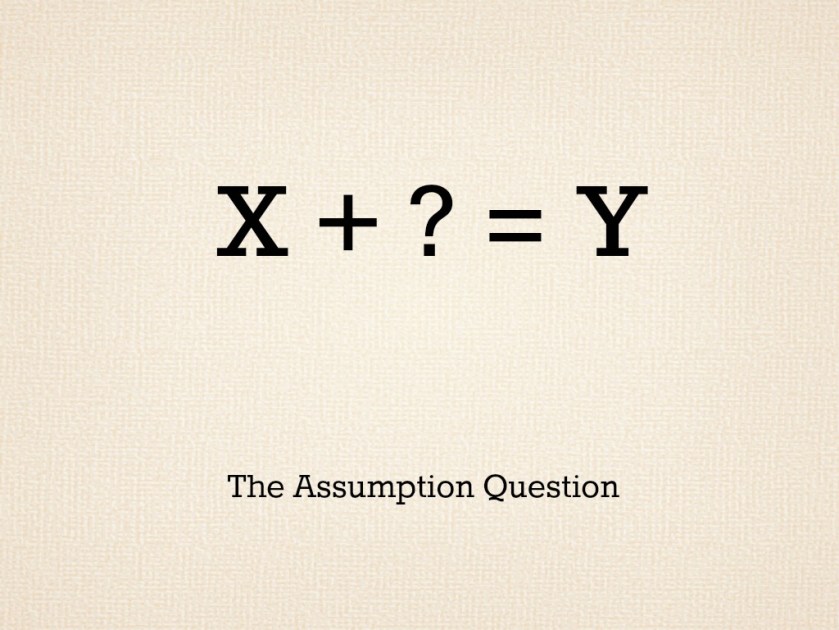
Q & A – The Assumption Question

Let’s discuss! In the previous post, we discussed the standard operating procedure to solve Assumption Questions – The Negation Method. The best way to really test whether you have understood a particular method of solving is to test it against tough questions. What makes a GMAT CR question tough? A tough question has trap options that are extremely relevant to the passage making it tough to eliminate them. Also, unlike a medium-level question, a tough question might have three close options, two which are very close and one close enough to be in the consideration set.

Critical Reasoning – The Assumption Question 1

The Assumption Question is a Critical Reasoning Question Type on the GMAT® that gives test-takers a certain amount of trouble (the most troublesome being the Boldfaced Question Type). Test-takers often say that they have trouble in attaining a certain level of consistency on this question type. In this post we shall look at a standard operating procedure that will help you increase your accuracy level and choose the right option when faced with two seemingly correct options.

Sentence Correction – Usage 1

This is a common and seemingly easily resolvable grammatical conundrum — when does one use which and when does one use that? Most test-takers who have prepared for GMAT® Sentence Correction will have this answer at the tip of their tongues — essential/restrictive and non-essential/non-restrictive clause. What they mean is that which is used to state information that is not essential while that is used to state essential information. A easier way to remember this is by looking at the pair of sentences below: 1. These are the keys to the fourth car in the parking row, which is black. 2. These are the keys to the fourth car in the parking row that is black. From the first sentence you would get the keys to the fourth car in the parking row; the sentence gives you some additional information, namely that it is black in colour; even without this information you could have known which car you have the keys to — the fourth car in the row.

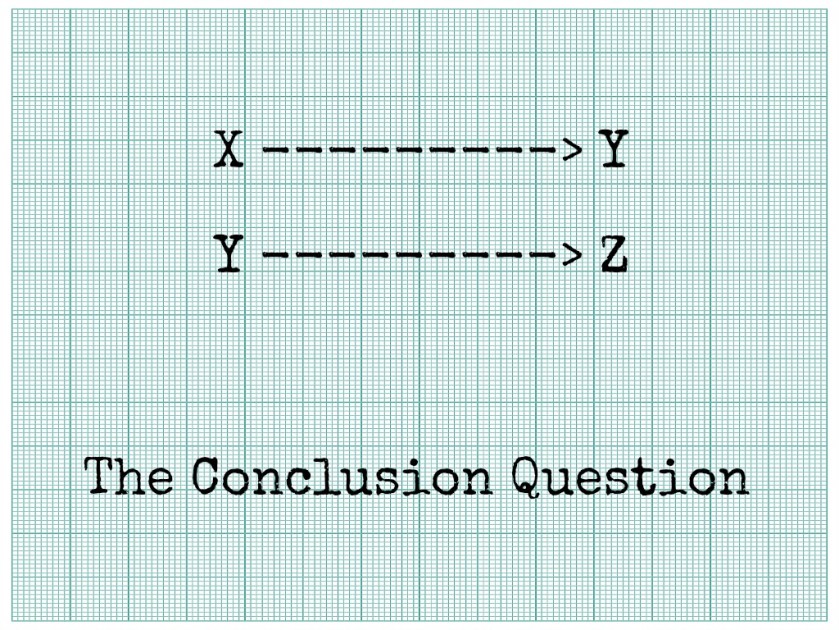
Critical Reasoning – The Conclusion Question 2

In the previous Critical Reasoning post we discussed one specific kind of logic that is tested on the Conclusion Question Type. In this post we will take a look at the only other type of standard logic tested on the conclusion questions. If you are able to understand apply the technique to solve these two logical structures, most conclusion questions should be a breeze. Let us take a GMAT Critical Reasoning question to examine this further. Although aspirin has been proven to eliminate moderate fever associated with some illnesses, many doctors no longer routinely recommend its use for this purpose. A moderate fever stimulates the activity of the body’s disease-fighting white blood cells and also inhibits the growth of many strains of disease-causing bacteria.